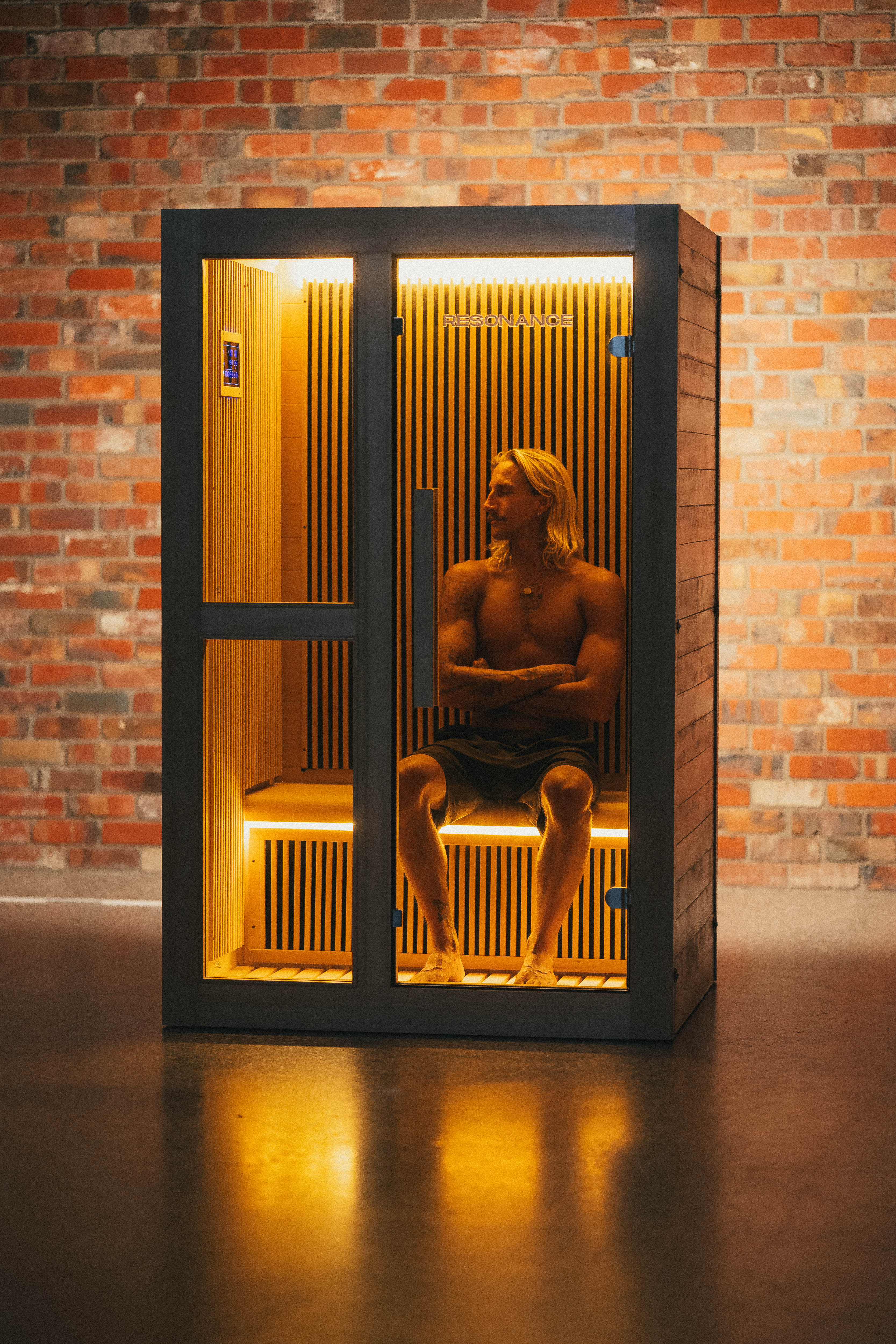
What Happens to Your Body in 20 Minutes Inside an Infrared Sauna
Twenty minutes is not a long time. It is the length of a short lunch break, a podcast episode, a warm-up run. But twenty minutes inside a full spectrum infrared sauna triggers a cascade of physiological responses so comprehensive that researchers have compared the cardiovascular load to moderate aerobic exercise, documented significant improvements in cellular repair, and measured meaningful reductions in inflammatory markers — all from sitting still in a warm cedar room.
This article documents what the peer-reviewed science says happens inside your body during those twenty minutes, in the order it happens, and why each response matters for athletic performance, recovery and long-term health.
Minutes 0–5: Core Temperature Begins to Rise
The moment you step inside a full spectrum infrared sauna, infrared wavelengths begin penetrating your tissue. Unlike a traditional sauna — which heats the air and warms your body from the outside in — infrared energy is absorbed directly by your soft tissue, initiating a rise in core body temperature from the inside out.
Within the first two to three minutes, your hypothalamus detects this temperature increase and begins initiating the thermoregulatory response. Blood is redirected from your core organs toward your peripheral vasculature — your skin — in an attempt to dissipate heat. This peripheral vasodilation is one of the most therapeutically significant early responses.
As blood vessels dilate, blood flow to the skin and superficial musculature increases substantially. Research published in the American Journal of Physiology has documented increases in skin blood flow of up to 50 to 70% during passive heat exposure, driven by the release of nitric oxide from the endothelial cells lining your blood vessels. This is the same vasodilatory mechanism that occurs during aerobic exercise, which is one reason researchers describe sauna use as a form of passive cardiovascular conditioning.
Sweating typically begins within the first five minutes for acclimatised individuals, though the onset depends on ambient temperature, session frequency and individual physiology. This early sweating is primarily a thermoregulatory response at this stage — the deeper detoxification processes develop over the following minutes.
Minutes 5–10: Cardiovascular Load Escalates
By the five to ten minute mark your cardiovascular system is working measurably harder. Heart rate has typically climbed to between 100 and 120 beats per minute — a range comparable to a brisk walk or light jog. Cardiac output increases as your heart pumps a larger volume of blood to the dilated peripheral vessels. Stroke volume — the amount of blood ejected per heartbeat — rises as the cardiovascular system responds to the increased demand.
This cardiovascular load is not stress in the pathological sense. It is a controlled physiological challenge of the same kind that occurs during moderate exercise, and the research documents that it produces similar adaptations over time.
The landmark Kuopio Ischaemic Heart Disease Risk Factor Study — a prospective cohort study tracking 2,315 Finnish men over 20.7 years, published in JAMA Internal Medicine by Laukkanen et al. in 2015 — found that men who used a sauna four to seven times per week had a 63% lower risk of sudden cardiac death and a 40% reduction in all-cause mortality compared to those who used one only once per week. These are extraordinary effect sizes, comparable to the benefits associated with regular physical exercise and statin therapy, and they persist after controlling for confounding variables including physical activity levels, smoking and alcohol consumption.
A 2024 meta-analysis published in the European Journal of Preventive Cardiology, reviewing 17 studies involving 2,264 participants, found that regular infrared sauna use improved arterial function — measured by flow-mediated dilation, a standard clinical test of blood vessel health — by 24 to 36% after four weeks of consistent sessions.
In the five to ten minute window, your body is also beginning to activate heat shock proteins. These molecular chaperones — proteins that assist in the correct folding, repair and disposal of other proteins — are produced in response to cellular heat stress. Heat shock protein 72 in particular, which has been documented to increase by approximately 50% after a single sauna session, plays a critical role in protecting cells from damage, supporting cellular repair and reducing oxidative stress. Their activation at this stage is one of the mechanisms through which regular sauna use produces long-term adaptations beyond those of any single session.
Minutes 10–15: Deep Tissue Response and Hormonal Shifts
Between ten and fifteen minutes, several important processes are deepening and converging.
Sweating is now substantial. The research on sweat-based detoxification is nuanced — some marketing claims in the sauna industry overstate the evidence — but the peer-reviewed literature does document meaningful excretion of specific compounds through sweat during infrared sauna use. A 2023 study published in the Journal of Environmental Science and Health found elevated concentrations of heavy metals including aluminium, arsenic, cadmium and lead in sweat collected during infrared sauna sessions, with concentrations significantly higher than those found in sweat from conventional exercise.
The hormonal environment is shifting. Growth hormone secretion increases in response to heat stress, with research documenting increases ranging from two to five-fold above baseline levels during single sessions, and up to 16-fold with repeated exposures — an effect mediated through the hypothalamic-pituitary axis responding to thermal stimulation. Growth hormone plays a central role in tissue repair, fat metabolism, muscle protein synthesis and the maintenance of lean body mass, particularly as natural growth hormone production declines with age from approximately the third decade of life onward.
Cortisol — the primary glucocorticoid stress hormone — follows an interesting trajectory during infrared sauna sessions. Research by Ahokas et al., published in Temperature: Multidisciplinary Biomedical Journal in 2025, investigated the cortisol response to post-exercise infrared sauna in female athletes over a six-week intervention period. The study found that while cortisol initially rises during early sessions in response to the thermal stress, with repeated exposure this cortisol response attenuates — suggesting that the body adapts to sauna as a stressor, producing a progressively smaller stress hormone response over time. This adaptation has significant practical implications for athletes seeking to manage the cumulative stress load of training.
Near infrared wavelengths — present in a full spectrum sauna but absent from far infrared only units — are actively stimulating cytochrome c oxidase in the mitochondria throughout this period. This photobiomodulation effect increases adenosine triphosphate production, accelerates cellular repair mechanisms and reduces markers of oxidative damage at the cellular level. Over 3,000 peer-reviewed studies have documented these photobiomodulation effects, making near infrared one of the most extensively researched wavelengths in all of photomedicine.
Minutes 15–20: The Recovery Window Opens
In the final five minutes of a twenty-minute session, the accumulated physiological responses reach their therapeutic peak.
Core temperature has typically risen by one to two degrees Celsius above baseline. This elevation is sufficient to trigger the full suite of heat stress adaptations without producing excessive physiological burden for healthy individuals — it represents what researchers describe as the therapeutic window of heat exposure.
The anti-inflammatory cascade initiated by heat shock proteins and the improved circulation driven by vasodilation is now operating at full capacity. A 2023 study published in Biology of Sport by Ahokas et al. — one of the most directly relevant pieces of research for athletes using post-training sauna — found that a single twenty-minute infrared sauna session performed after resistance exercise significantly improved recovery of neuromuscular performance and reduced subjective muscle soreness compared to passive recovery. The protocol used a temperature of 43 degrees Celsius over twenty minutes immediately following training — a finding consistent with the vasodilatory, anti-inflammatory and cellular repair mechanisms operating during this phase of the session.
A 2025 study published in Frontiers in Sports and Active Living by Ahokas et al. extended this research across a six-week intervention in forty female team sport athletes. Those using post-exercise infrared sauna demonstrated 18% greater improvements in maximal voluntary contraction — a measure of neuromuscular performance — compared to athletes using passive recovery methods alone.
The parasympathetic nervous system is also increasingly active toward the end of a session. Heart rate variability research on sauna users has documented a shift toward parasympathetic dominance — the rest and digest state — both during and after sessions. This shift has meaningful implications for sleep quality, stress recovery and the autonomic balance that elite athletes increasingly monitor as a marker of readiness and recovery status.
After the Session: The Adaptation Window
What happens in the hours after a twenty-minute infrared sauna session is as important as what happens during it.
Core temperature begins to decline as you leave the sauna, and this thermoregulatory cooling — a fall in body temperature — is one of the most powerful signals for sleep onset. Research has documented that this post-sauna cooling effect improves both sleep latency (the time it takes to fall asleep) and deep slow-wave sleep quality, with one large survey of regular sauna users finding that 83% reported improved sleep following sessions.
Growth hormone continues to be secreted for sixty to one hundred and twenty minutes following the session, peaking approximately thirty minutes after the thermal stimulus concludes.
The cardiovascular system gradually returns to baseline, but the adaptations accumulated through regular sessions persist. Plasma volume — the fluid component of blood — increases with regular heat exposure, improving cardiovascular efficiency and thermoregulatory capacity during subsequent exercise. A 2024 study in the Journal of Applied Physiology found that heat acclimation through regular sauna use increased plasma volume by 7.1% after ten sessions conducted over two weeks.
The Protocol the Research Supports
Based on the peer-reviewed literature, the following protocol produces the most comprehensive physiological response:
Temperature: 43 to 50 degrees Celsius for infrared saunas. Higher temperatures do not necessarily produce proportionally greater benefit and increase the risk of excessive heat stress.
Duration: 20 to 30 minutes per session. The research consistently identifies twenty minutes as sufficient to trigger the full cascade of cardiovascular, hormonal and cellular responses documented above.
Timing: Post-training. The research on post-exercise infrared sauna — particularly Ahokas et al. 2023 — specifically documents enhanced recovery when the session is conducted after training rather than before. Pre-training sauna carries risks of dehydration and pre-fatigue that can impair performance and increase injury risk.
Frequency: Three to four sessions per week minimum for measurable cardiovascular and recovery adaptations. Four to seven sessions per week for maximum longevity-associated benefits, as documented in the Laukkanen studies.
What Twenty Minutes Inside an Infrared Sauna Does — In Summary
- Minutes 0 to 5: Core temperature rises. Peripheral vasodilation begins. Heart rate starts climbing. Blood flow to soft tissue increases by up to 50 to 70%.
- Minutes 5 to 10: Cardiovascular load reaches 100 to 120 beats per minute. Heat shock proteins activate. Nitric oxide release drives arterial conditioning equivalent to moderate aerobic exercise.
- Minutes 10 to 15: Sweating deepens. Growth hormone secretion increases two to five-fold. Cortisol response attenuates with repeated exposure. Near infrared photobiomodulation drives cellular ATP production and repair.
- Minutes 15 to 20: Neuromuscular recovery is enhanced. Anti-inflammatory cascade peaks. Parasympathetic nervous system activity increases. The therapeutic window closes.
- After the session: Core temperature decline signals sleep onset. Growth hormone continues secreting for sixty to one hundred and twenty minutes. Plasma volume adaptations accumulate over repeated sessions.
Twenty minutes. Sitting still. In a warm cedar room.
The science says it is enough to matter.
Sources
Laukkanen, T., Khan, H., Zaccardi, F., Laukkanen, J.A. (2015). Association Between Sauna Bathing and Fatal Cardiovascular and All-Cause Mortality Events. JAMA Internal Medicine, 175(4), 542–548.
Ahokas, E.K., Ihalainen, J.K., Hanstock, H.G., Savolainen, E., Kyröläinen, H. (2023). A post-exercise infrared sauna session improves recovery of neuromuscular performance and muscle soreness after resistance exercise training. Biology of Sport, 40(3), 681–689.
Ahokas, E.K., Kyröläinen, H., Ihalainen, J.K., Hanstock, H.G. (2025). Effects of repeated use of post-exercise infrared sauna on neuromuscular performance and muscle hypertrophy. Frontiers in Sports and Active Living.
Ahokas, E.K., Kyröläinen, H., Ihalainen, J.K., Hanstock, H.G. (2025). Salivary cortisol response to post-exercise infrared sauna declines over time. Temperature: Multidisciplinary Biomedical Journal.
European Journal of Preventive Cardiology (2024). Meta-analysis of infrared sauna use and arterial function. 17 studies, 2,264 participants.
Hamblin, M.R. (2017). Mechanisms and applications of the anti-inflammatory effects of photobiomodulation. AIMS Biophysics, 4(3), 337–361.
Laukkanen, J.A., Kunutsor, S.K. (2024). The multifaceted benefits of passive heat therapies for extending the healthspan. Temperature: Multidisciplinary Biomedical Journal.